
Tubesteader Gainlord
Gainlord
£325.00
Item successfully added to your basket
Highlights
- Dual-channel high-voltage valve preamp and overdrive
- British amplifier tones spanning the late 1960s through 1980s
- Open, gritty low-gain channel with warm low-end sag
- Tight, aggressive high-gain channel with defined attack
- Two genuine 12AX7 ECC83 valves
- Independent Volume, Gain and three-band EQ for each channel
- Individual Bright switches add presence to both channels
- High-gain Bright switch provides a subtle gain increase
- Touch-sensitive response cleans naturally from guitar volume
- Tone Cut adapts the output for different signal chains
- Connects to an amplifier, power amp or cabinet simulator
- Remote channel and high-gain Bright switching capability
- Separate channel selection and effect bypass footswitches
- True-bypass switching
- Included 12V DC 500 mA power supply
- Battery operation not supported
- Handmade in Montreal, Canada
- Metallic gold die-cast aluminium enclosure
- Protective metal rails shield the exposed valves
- Five-year limited parts and craftsmanship warranty
Description
The Tubesteader Gainlord is a dual-channel valve preamp and overdrive designed to place the punch, harmonic density and responsive gain structure of classic British amplifiers onto a modern pedalboard. Its two independent channels cover the development of hard rock guitar tone from open late 1960s breakup through tighter and more aggressive 1980s gain, allowing it to function as a two-stage drive pedal, a complete preamp or the core of a compact direct rig.
The low-gain channel produces an open and gritty response with the Gain control set around nine o’clock, placing the sound close to the edge of breakup. Increasing the gain develops a grainier crunch while the lower frequencies begin to sag, adding warmth, body and a less rigid feel beneath chords. This makes the channel particularly effective for dynamic rhythm work, classic rock drive and lower-gain lead sounds that need harmonic texture without excessive compression.
The high-gain channel is tighter, more forceful and more immediate. Its firmer low-frequency response keeps palm-muted parts controlled, while additional top-end bite helps individual notes remain clear as saturation increases. It provides the stronger attack and more focused structure associated with later British hard rock amplifiers, but still retains enough dynamic range to avoid feeling flat or disconnected from the instrument.
Both channels respond naturally to changes in picking strength and guitar volume. Lighter playing reduces the density of the overdrive, while a harder attack brings additional harmonic content and edge into the sound. The high-gain channel also cleans up when the guitar’s volume control is reduced, making it possible to move between cleaner rhythm textures and fuller drive without returning to the pedal between passages.
Each channel has its own Volume, Gain, Treble, Mid and Bass controls. The two sides can therefore be configured as genuinely different amplifier voices rather than simply providing two gain levels. The low-gain channel can be kept broad and warm for rhythm work while the high-gain side is tightened, brightened and levelled for leads. Alternatively, both channels can be matched for volume and used to switch between softer vintage sag and a more controlled modern attack.
Independent Bright switches add presence to each channel without requiring the main Treble controls to be raised. On the low-gain side, Bright can restore articulation when using darker pickups or an amplifier with a softer top end. On the high-gain channel, the switch also introduces a subtle increase in gain, adding urgency and cut for lead work or more aggressive rhythm sounds.
The Tone Cut function changes the way the Gainlord interfaces with the next stage of the rig. Its full-output setting provides approximately eighty percent of standard line level and is intended for use as a dedicated preamp feeding a power amplifier or cabinet simulator. The alternative setting lowers the output and scoops the high-mid response, allowing the Gainlord to sit more naturally in front of a conventional guitar amplifier without overwhelming its input stage.
This flexible output architecture allows the pedal to serve several distinct roles. In front of a clean amplifier, it operates as a two-channel valve overdrive with complete tone shaping. Connected to a power amplifier and guitar cabinet, it becomes the main preamp for a compact live or rehearsal rig. Paired with a cabinet simulator, it can provide the gain and equalisation section of a direct recording setup while leaving speaker and microphone character to the following equipment.
A 3.5 mm TRS remote connection provides external control over channel selection and the high-gain Bright function. This is useful when the Gainlord is mounted away from the front row of a larger pedalboard or integrated with a compatible switching system. The onboard Channel footswitch remains available for direct selection, while the separate Bypass footswitch engages or removes the complete preamp circuit from the signal path.
At the centre of the Gainlord are two 12AX7 ECC83 valves operating within a real high-voltage circuit. Rather than using a valve primarily as a visual feature or low-voltage clipping element, the circuit is designed to reproduce the punch, harmonic richness and touch-sensitive behaviour associated with traditional valve amplifier gain stages. The two-channel architecture then shapes that response into contrasting open and tight voices.
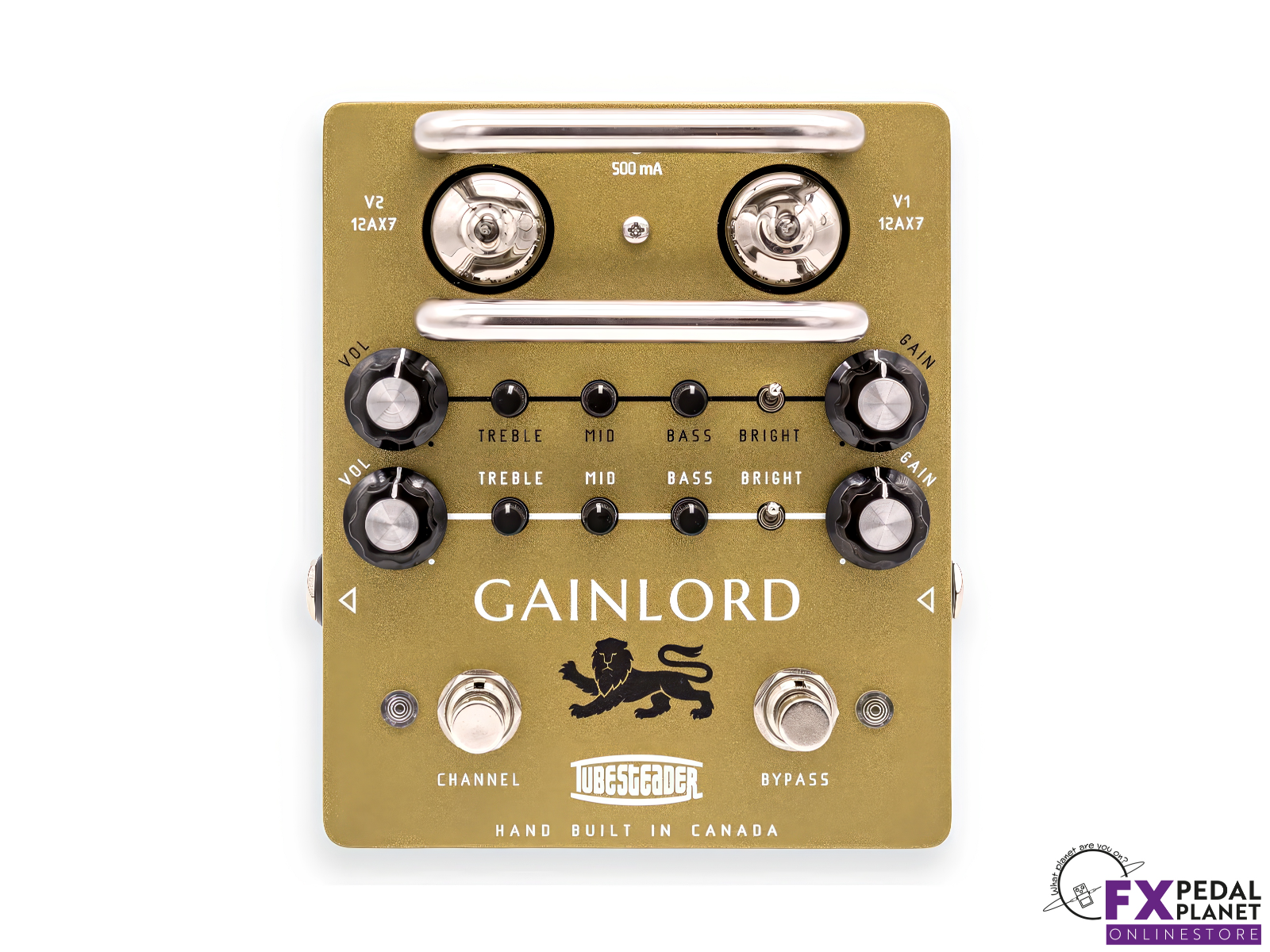
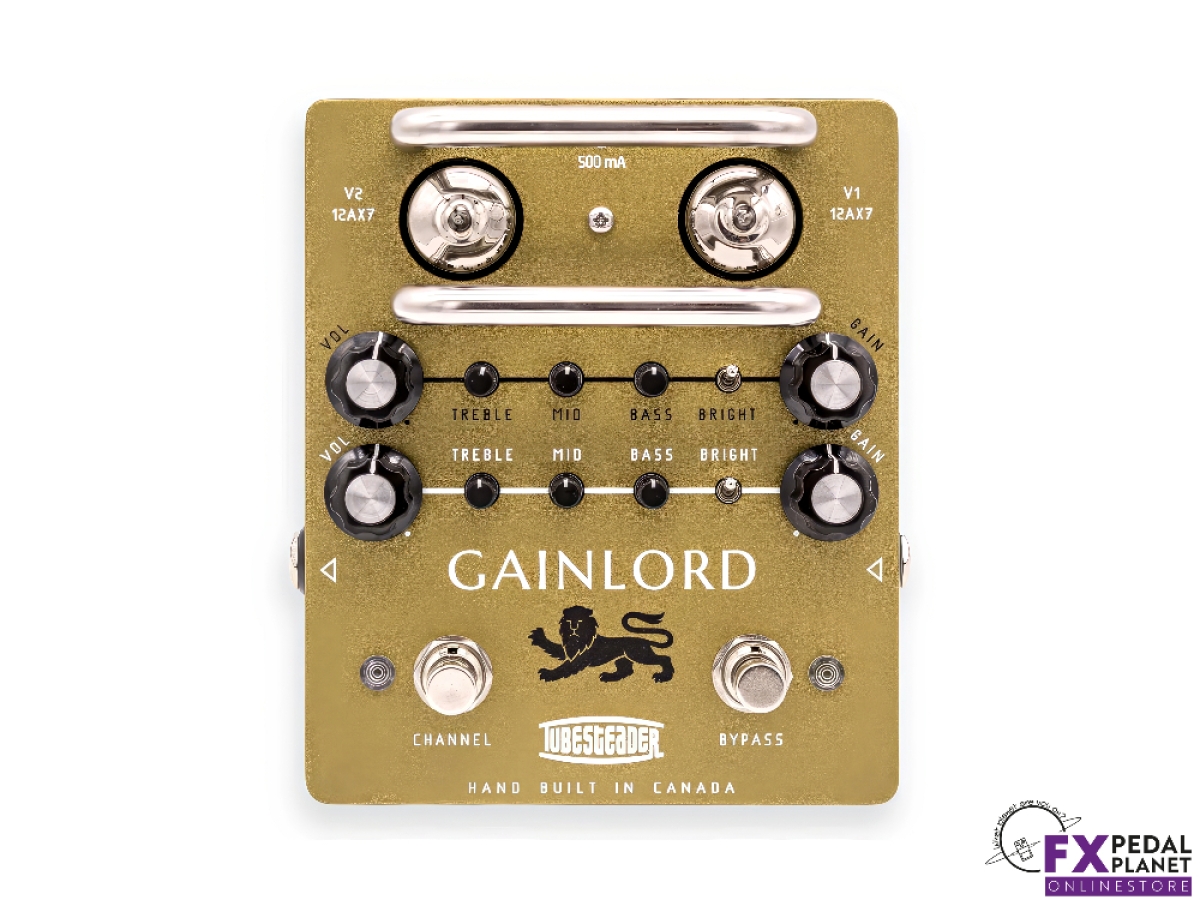
True-bypass switching preserves the unaffected signal when the pedal is disengaged, while separate LEDs show the active channel and bypass status. The clearly divided control rows make both channel settings easy to read, with the larger Volume and Gain controls positioned at the outer edges and the three-band equalisation placed centrally. This layout supports quick comparisons between channels during rehearsals, recording sessions and live use.
The metallic gold die-cast aluminium enclosure provides a rigid foundation for the circuit and control hardware. Two substantial metal rails protect the exposed valves from direct knocks while leaving them visible and accessible. Black controls, silver caps, white labelling and the central lion graphic provide strong contrast against the gold surface, giving the pedal a distinctive appearance without compromising control visibility.
Power is supplied by the included 12V DC 500 mA adapter. A compatible isolated pedalboard supply can also be used, provided it delivers 12V DC through a centre-negative 5.5 x 2.1 mm connection and supplies the required current. Two suitable 12V outputs may be combined with a current-doubling cable when one output cannot provide 500 mA. The supply voltage must never exceed 12V DC, and battery operation is not supported.
Each Gainlord is built by hand in Tubesteader’s Montreal workshop. The pedal is covered by a five-year limited warranty against defects in parts and craftsmanship, with separate warranty periods applying to external hardware and valves. Its high-voltage valve architecture, independently voiced channels and adaptable output stage make it a practical choice for players who want authentic amplifier-style gain without committing their complete sound to one amplifier or signal-chain configuration.
Controls
- Low-Gain Volume: Sets the output level of the open, vintage-voiced channel.
- Low-Gain Treble: Adjusts high-frequency bite, clarity and pick definition.
- Low-Gain Mid: Controls the channel’s midrange presence and position within a mix.
- Low-Gain Bass: Adjusts low-frequency weight and the prominence of the channel’s natural sag.
- Low-Gain Bright Switch: Adds presence and articulation to the low-gain channel.
- Low-Gain Gain: Moves the channel from edge-of-breakup grit into grainy British crunch.
- High-Gain Volume: Sets the output level of the tighter, more aggressive channel.
- High-Gain Treble: Adjusts upper-frequency bite and note definition at higher gain settings.
- High-Gain Mid: Controls the high-gain channel’s projection, body and mix presence.
- High-Gain Bass: Adjusts low-frequency weight while retaining the channel’s tighter response.
- High-Gain Bright Switch: Adds presence and introduces a subtle increase in gain.
- High-Gain Gain: Sets the amount of saturation from driven crunch to fuller hard rock gain.
- Tone Cut Switch: Selects full preamp output or a lower-level front-of-amplifier response with scooped high mids.
- Channel Footswitch: Selects between the independent low-gain and high-gain channels.
- Bypass Footswitch: Engages the Gainlord or returns the signal to true bypass.
- Remote Connection: Allows external channel selection and high-gain Bright switching through a 3.5 mm TRS connection.
Components and Technical Specification
- Dual-channel valve preamp and overdrive circuit
- Real high-voltage valve architecture
- Two 12AX7 ECC83 valves
- British amplifier-inspired voicing
- Independent low-gain and high-gain channels
- Low-gain channel with open, gritty response
- High-gain channel with tighter, more aggressive response
- Independent Volume control for each channel
- Independent Gain control for each channel
- Independent Treble control for each channel
- Independent Mid control for each channel
- Independent Bass control for each channel
- Individual Bright switch for each channel
- Subtle gain increase from high-gain Bright switch
- Tone Cut output-mode selector
- Approximately eighty percent standard line-level maximum output
- Full-output preamp mode for power amps and cabinet simulators
- Reduced-output mode for front-of-amplifier operation
- Scooped high-mid response in overdrive-pedal mode
- 3.5 mm TRS remote switching connection
- Remote channel selection
- Remote high-gain Bright control
- Separate Channel and Bypass footswitches
- Separate channel and effect status indicators
- True-bypass switching
- Mono 6.35 mm input and output connections
- 12V DC power requirement
- 500 mA power requirement
- Centre-negative polarity
- 5.5 x 2.1 mm barrel connection
- 12V DC power adapter included
- Current-doubling cable compatible
- Do not exceed 12V DC
- Battery operation not supported
- Die-cast aluminium enclosure
- Protective valve rails
- Metallic gold finish
- Handmade in Montreal, Canada
- Five-year limited parts and craftsmanship warranty
- One-year warranty for external pots, switches and jacks
- Thirty-day valve warranty
Enclosure Dimensions
- Length: 120 mm / 4.72 in
- Width: 145 mm / 5.71 in
- Height: 70 mm / 2.76 in, including valve protectors
Weight
- 800 g
- 1.76 lb


Payment methods accepted